
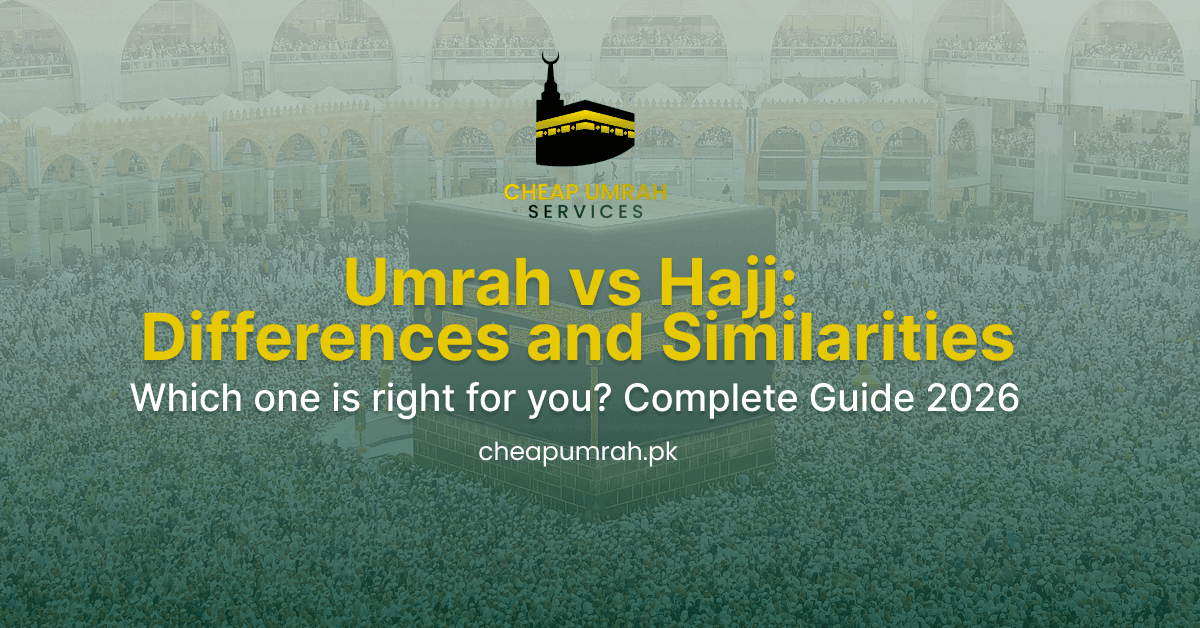
Every Muslim dreams of visiting Makkah. When you plan your journey, you will find two paths: Umrah and Hajj. They are not the same. One is a compulsory pillar of Islam, while the other is a voluntary blessing. This guide breaks down what makes them unique so you can prepare for your trip with clarity.
Whether you want to travel soon or just need to learn the basics, you will find everything you need below. We cover the 10 core differences, shared rituals, costs for Pakistani travelers, and scholarly views.
📖 In This Guide
- What Is Umrah?
- What Is Hajj?
- Is Hajj or Umrah Mandatory (Farz)?
- Similarities Between Hajj and Umrah
- 10 Key Differences Between Hajj and Umrah
- Rituals Comparison: Step by Step
- Cost Comparison: Hajj vs Umrah from Pakistan
- When Can You Perform Each Pilgrimage?
- What Do Islamic Scholars Say? (IslamQA Perspective)
- Should You Do Umrah Before Hajj?
- Frequently Asked Questions (10 FAQs)
- Conclusion
What Is Umrah?
Umrah is a voluntary trip to the holy city of Makkah. The word means "to visit a populated place" in Arabic. People often call it the "minor pilgrimage," but it still holds massive spiritual value. It is a beautiful way to refresh your faith and seek forgiveness.
You can perform Umrah at any time of the year. There is no set season. Traveling during winter, summer, or Ramadan is completely fine. The Prophet Muhammad (peace be upon him) noted that doing Umrah in Ramadan brings a reward equal to performing Hajj with him. This is why many families from Pakistan book their trips during that holy month.
Umrah requires only four basic steps:
- Putting on the Ihram sheets and making a sincere intention (Niyyah)
- Performing Tawaf (walking around the Kaaba seven times)
- Performing Sa'i (walking seven times between the hills of Safa and Marwa)
- Cutting or shaving your hair (Halq or Taqsir) to exit Ihram
Once you finish these steps, your Umrah is complete. You can spend the rest of your trip praying in Makkah and Madinah or visiting historical sites.
What Is Hajj?
Hajj is the fifth pillar of Islam. Every Muslim who is healthy and has enough money must perform it at least once in their life. It is an incredible event that brings millions of believers from all corners of the earth together in Makkah every year.
You cannot perform Hajj whenever you want. It only takes place during fixed days in Dhul Hijjah, the final month of the Islamic calendar. The peak of the journey happens on the 9th of Dhul Hijjah on the plains of Arafat. The Prophet (peace be upon him) made it clear that staying at Arafat is the core of Hajj.
Hajj takes at least five days and involves a longer series of rituals:
- Changing into Ihram at the boundary line (Miqat)
- Moving to Mina to spend the night on the 8th of Dhul Hijjah
- Standing and praying on the plains of Arafat on the 9th of Dhul Hijjah
- Spending the night under the stars in Muzdalifah to collect small pebbles
- Returning to Mina to throw pebbles at the Jamarat pillars
- Offering an animal sacrifice (Qurbani) on Eid al-Adha
- Shaving or trimming your hair
- Going to Makkah for Tawaf al-Ifadah around the Kaaba
- Walking seven times between Safa and Marwa
- Staying in Mina for the final days of the ritual
- Performing the farewell Tawaf (Tawaf al-Wada) before heading home
📌 Quick Reminder
You only need to perform Hajj once to fulfill your compulsory duty. If you go again later in life, those journeys count as voluntary acts of worship.
Is Hajj or Umrah Mandatory (Farz)?
Many pilgrims from Pakistan ask about the legal status of these trips. The rules are straightforward under mainstream Islamic law:
🕌 Hajj — Compulsory (Farz)
- It stands as the fifth pillar of the Islamic faith
- Adult Muslims must complete it once if they have the physical health and money
- Skipping Hajj when you are able to go is considered a serious sin
- The Quran states: "Pilgrimage to the House is a duty owed to Allah by people who are able to undertake it."
🌙 Umrah — Highly Recommended (Sunnah)
- The Hanafi and Maliki schools look at Umrah as a strongly encouraged Sunnah
- The Shafi'i and Hanbali schools view it as a mandatory duty once in a lifetime
- Umrah does not count as a replacement for your mandatory Hajj
- There is no sin for skipping it under Hanafi law, but going brings immense rewards
For most Pakistani travelers who follow the Hanafi school, Hajj is a strict obligation, while Umrah is a voluntary act of devotion. Both remain deeply rewarding journeys that bring you closer to Allah.
Similarities Between Hajj and Umrah
Even though they are different types of worship, they share several core rituals. Recognizing these common points makes it easier to understand how to perform them.
| Shared Element | How It Appears in Umrah | How It Appears in Hajj |
|---|---|---|
| Ihram | You enter this state at the Miqat before reaching Makkah | You enter this state before or on the 8th of Dhul Hijjah |
| Tawaf | You walk around the Kaaba seven times | You complete multiple Tawafs during the five days |
| Sa'i | You walk seven times between Safa and Marwa | You perform the exact same walk between the two hills |
| Halq / Taqsir | You trim or shave hair to complete the trip | You cut your hair on the 10th of Dhul Hijjah after sacrifice |
| Intention (Niyyah) | You make a formal intention at the start | You make a formal intention at the start |
| Spiritual Focus | You avoid bad language and maintain purity | You follow the same strict rules of behavior |
| Holy Site | The Kaaba forms the center of your prayers | The Kaaba remains the central focus of your worship |
| City Base | The main steps happen inside Makkah | The trip starts in Makkah and moves to nearby fields |
The spiritual goal of both trips is identical: leaving worldly worries behind, asking for forgiveness, and focusing entirely on Allah. Both journeys help wash away sins. The Prophet (peace be upon him) promised that a properly performed Hajj cleanses a person completely, and similar blessings apply to Umrah.
10 Key Differences Between Hajj and Umrah
To help you see how they contrast, here are the ten biggest differences between Hajj and Umrah:
- Status in Religion Hajj is a core pillar of Islam and a compulsory duty (Farz) for those who can afford it. Umrah is a voluntary Sunnah under Hanafi law and is not an absolute requirement.
- Timing and Dates Hajj happens only once a year during specific days in the month of Dhul Hijjah. Umrah can be done on any day of the year, across all twelve months.
- Time Required Hajj takes at least five days of moving between holy camps. Umrah rituals take only three to five hours to finish, though most pilgrims stay in the country for a couple of weeks to pray.
- Steps and Rituals Umrah has only four main steps: Ihram, Tawaf, Sa'i, and hair cutting. Hajj includes all of these along with staying in Mina, standing at Arafat, sleeping in Muzdalifah, throwing stones, and sacrificing an animal.
- The Plain of Arafat Spending the day praying at Arafat on the 9th of Dhul Hijjah is an absolute requirement for Hajj. If you skip it, your Hajj does not count. Umrah does not include this step; you do not visit Arafat during the journey.
- Animal Sacrifice Hajj requires an animal sacrifice (Qurbani) to complete the rituals for most types of packages. Umrah has no sacrifice rule; you do not need to buy or slaughter an animal.
- Crowd Levels Because Hajj happens on fixed dates for everyone, it creates one of the biggest annual gatherings on earth. Umrah is spread across the year, so daily crowds are typically much smaller, except during Ramadan.
- Visa and Booking Quotas The Saudi government gives a limited number of Hajj spots to Pakistan each year through a strict system run by the Ministry of Religious Affairs. Umrah has no such limits; anyone can apply for an Umrah visa at any time.
- Total Expenses Hajj is far more expensive because it involves extra transport, five days of tent accommodations, and longer hotel stays. Umrah is a highly affordable choice for families on a budget.
- Spiritual Standing Hajj holds a higher rank because it fulfills a foundational pillar of Islam. An accepted Hajj completely resets a person's slate of deeds. Umrah brings massive rewards and wipes away sins between journeys, but it cannot equal the importance of Hajj.
Quick Reference: Hajj vs Umrah Comparison
| Factor | Hajj | Umrah |
|---|---|---|
| Religious Status | Compulsory Pillar (Farz) | Highly Recommended (Sunnah) |
| Available Months | Dhul Hijjah only | All year round |
| Days Needed | 5 to 6 days minimum | 3 to 5 hours total |
| Ihram Sheet | Required | Required |
| Tawaf around Kaaba | Multiple times | Once per Umrah |
| Sa'i Walk | Required | Required |
| Day at Arafat | Core Requirement | Not included |
| Nights in Mina | Required | Not included |
| Muzdalifah Stay | Required | Not included |
| Stoning Jamarat | Required | Not included |
| Qurbani Sacrifice | Required for most | Not included |
| Government Quotas | Yes (Strict limits) | No (Open booking) |
| Starting Costs | Higher (PKR 1,400,000+) | Lower (PKR 200,000+) |
| Fulfillment | Once in a lifetime covers it | Can be done repeatedly |
Rituals Comparison: Step by Step
Seeing the steps side-by-step makes it easy to understand how these journeys progress.
🌙 Umrah Rituals (4 Steps)
- Step 1: Change into Ihram sheets at the Miqat line and state your intention.
- Step 2: Complete seven rounds around the Kaaba (Tawaf).
- Step 3: Walk seven times between the hills of Safa and Marwa (Sa'i).
- Step 4: Cut or shave your hair to complete your package and leave Ihram.
🕌 Hajj Rituals (Main Steps)
- 8th Dhul Hijjah: Put on Ihram, drive to Mina, and stay in the tents overnight.
- 9th Dhul Hijjah: Move to Arafat to pray from midday until the sun sets.
- 9th Night: Walk or ride to Muzdalifah, gather stones, and sleep on the ground.
- 10th Dhul Hijjah: Return to Mina and throw your stones at the large pillar.
- 10th Dhul Hijjah: Arrange your animal sacrifice (Qurbani).
- 10th Dhul Hijjah: Cut or shave your hair to leave the strict state of Ihram.
- 10th Dhul Hijjah: Visit the grand mosque for Tawaf al-Ifadah.
- 10th Dhul Hijjah: Complete your Sa'i walk between the two hills.
- 11th–13th: Live in Mina and stone all three pillars every afternoon.
- Final Day: Complete the farewell Tawaf before you exit the city.
Cost Comparison: Hajj vs Umrah from Pakistan
The price difference between Hajj and Umrah is quite large. Hajj requires specialized transportation networks, secure tent management in fields outside Makkah, and longer hotel stays.
| Cost Factor | Hajj Packages | Umrah Packages |
|---|---|---|
| Official Government Scheme | PKR 1,400,000 – 2,000,000+ | Does not apply |
| Private Agency Booking | PKR 2,000,000 – 3,500,000+ | PKR 200,000 – 450,000+ |
| Flights | Included in package rate | Can be bundled or bought alone |
| Hotels (Makkah) | Included in your plan | Included based on hotel star tier |
| Hotels (Madinah) | Included in your plan | Included based on hotel star tier |
| Camp Fees (Mina/Arafat) | Compulsory cost | Does not apply |
| Animal Purchase | Compulsory (PKR 25,000–50,000) | Does not apply |
| Visa Fees | Built into package totals | Approx. PKR 15,000–25,000 |
| Average Length of Stay | 25 to 40 days | 7, 14, or 21 days typically |
💡 Useful Tip
If you cannot afford Hajj yet, booking an Umrah is a wonderful way to keep your connection to the holy sites alive. Our team helps families organize smooth, affordable trips. Check our visa page to find out more about timelines and requirements.
When Can You Perform Each Pilgrimage?
Choosing the right month is an important part of planning your travel schedule.
| Option | Season Details | What to Expect |
|---|---|---|
| Hajj | 8th–13th Dhul Hijjah only | Happens once a year. Applications open months early in Pakistan. |
| Standard Umrah | Autumn through early Spring | Mild weather and steady crowds. Great for senior citizens and kids. |
| Ramadan Umrah | The whole month of Ramadan | High crowd levels but incredible rewards. Make sure to book months ahead. |
| Winter Umrah | October through February | The most comfortable weather for walking long distances outside. |
For most families in Pakistan, traveling between October and February provides the most comfortable weather. The summer months in Saudi Arabia can be intensely hot, which is worth keeping in mind if you are traveling with elderly parents.
What Do Islamic Scholars Say? (IslamQA Perspective)
Scholars across different schools of thought agree on the value of both journeys, though they have slight differences regarding whether Umrah is mandatory:
- Hanafi School: Looks at Umrah as an emphasized Sunnah. You are not considered sinful if you skip it, but performing it brings great spiritual value.
- Shafi'i School: Teaches that Umrah is an absolute requirement once in a lifetime for those who can afford it, running parallel to Hajj.
- Maliki School: Defines it as a voluntary act of worship rather than a strict legal obligation.
- Hanbali School: Classifies Umrah as mandatory for anyone who has the means to make the journey.
📖 Scholar's Note
No matter which school of thought you follow, everyone agrees that Umrah is a beautiful deed that helps clear away past sins. The official Saudi platform for organizing your visas and booking entry permits is the Nusuk app, which you can access online before you fly.
Should You Do Umrah Before Hajj?
You do not need to wait until you complete Hajj to perform an Umrah. If you have the means to visit Makkah now, booking an Umrah is highly encouraged. It serves as excellent physical and spiritual practice for the larger crowds you will experience during Hajj later on.
If you want to combine both types of worship into a single journey during the Hajj season, you can choose Hajj al-Tamattu. This involves completing your Umrah first, exiting the state of Ihram to rest in your hotel, and then re-entered Ihram when the five days of Hajj begin. This is the most popular method for travelers from Pakistan.
The Three Forms of Hajj
Hajj can be performed in three distinct ways, depending on how you arrange your travel and intentions:
You make an intention for Hajj alone. You do not perform an Umrah on this journey and stay in Ihram until the final day. An animal sacrifice is not required.
The most common pick for Pakistani travelers. You complete an Umrah first during the Hajj season, change back into normal clothes, and enter Ihram again for Hajj on the 8th of Dhul Hijjah. A sacrifice is required.
You connect Hajj and Umrah into a single intention. You wear your Ihram for both and never take it off between the two journeys. An animal sacrifice is required.
Frequently Asked Questions
What is the main difference between Hajj and Umrah?
Hajj is a foundational pillar of Islam that must be done during specific days in Dhul Hijjah and includes camping at Arafat and Mina. Umrah is a shorter, voluntary prayer journey that you can complete in a few hours at any time of the year.
Is Umrah mandatory for Muslims?
For the Hanafi school followed by most Pakistanis, it is a highly encouraged Sunnah but not a mandatory requirement. Other schools of thought, like Shafi'i, consider it mandatory once in your life if you have the funds.
Can performing Umrah replace my Hajj obligation?
No. Umrah cannot replace Hajj. Hajj is a distinct pillar of faith with unique rituals. Going for Umrah does not fulfill your lifelong obligation to perform Hajj when you are financially able.
Which journey holds a higher reward?
Hajj carries a higher rank because it is a compulsory pillar of Islam. However, performing Umrah during the month of Ramadan offers a reward that is spiritually equivalent to performing Hajj with the Prophet (peace be upon him).
What steps are identical in both pilgrimages?
Both journeys require you to wear the white Ihram sheets, make a formal intention, walk around the Kaaba seven times (Tawaf), walk between Safa and Marwa (Sa'i), and clip your hair at the end.
How many days do I need for each trip?
Hajj requires at least 5 to 6 days of specific rituals in the fields outside Makkah. Umrah can be completed in 3 to 5 hours, though most travel packages last between 7 and 21 days so you can enjoy the mosques.
Are the clothing rules for Ihram the same?
Yes. Men must use two pieces of unstitched white cloth. Women can wear any modest, loose clothing that covers their body properly while keeping their face and hands uncovered.
What extra steps are only found during Hajj?
Hajj requires you to stay overnight in Mina, pray all day at Arafat, collect stones at Muzdalifah, stone the pillars, and offer an animal sacrifice on Eid day.
Can I do both Umrah and Hajj on the same journey?
Yes. This is called Hajj al-Tamattu. You complete your Umrah rituals first when you land, return to normal clothing to rest, and then put your Ihram back on when the Hajj days begin.
Why does Hajj cost so much more than Umrah?
Hajj requires special government registration fees, long-term accommodation in specific tent zones, and highly regulated transportation during peak travel days. Umrah can be arranged affordably throughout the year.
Conclusion
Hajj and Umrah are beautiful opportunities to stand before the Kaaba and seek forgiveness. While they share core rituals like Tawaf and Sa'i, they differ in timing, cost, steps, and religious obligation.
Hajj remains a lifetime pillar of faith that requires careful preparation and set dates. Umrah offers a flexible, affordable path to spiritual renewal that you can book whenever you feel ready to travel.
If you live in Rawalpindi or Islamabad and want to plan your next trip, our team is here to assist. We can guide you through visas, flight options, and hotel selections. Feel free to visit our office at Rania Mall, Saddar, or reach out to us online to start your journey.